


Understanding of How Stress Works


The autonomic nervous system (ANS) is the part of the peripheral nervous system that regulates involuntary body functions and helps maintain internal balance, or homeostasis. It controls processes such as heart rate, blood pressure, breathing, digestion, glandular secretion, body temperature regulation, urination, and sexual responses. Unlike the somatic nervous system, which governs voluntary movement, the ANS works largely without conscious effort. It does this by continuously receiving information from the body and the external environment and adjusting organ activity through coordinated nerve pathways.
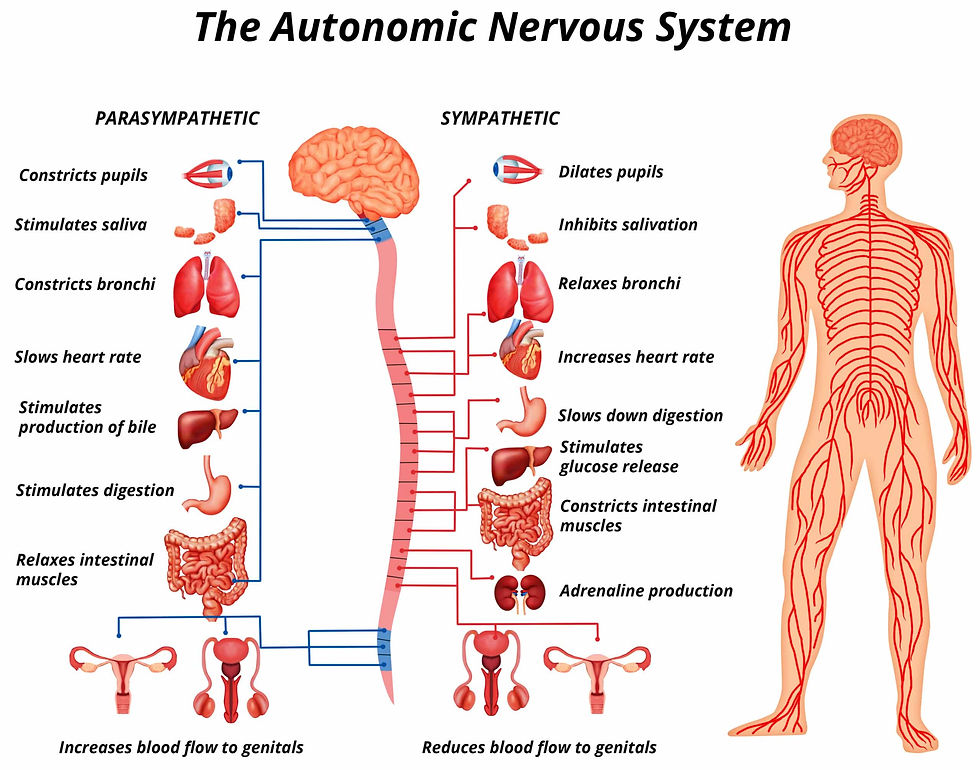
Overview of the Autonomic Nervous System
The ANS consists of interconnected pathways that link the brain and spinal cord to internal organs. In a typical autonomic pathway, a preganglionic neuron originates in the central nervous system and synapses in an autonomic ganglion with a postganglionic neuron, which then reaches the target organ. This arrangement allows the ANS to regulate smooth muscle, cardiac muscle, and glands. Major centers involved in autonomic control include the hypothalamus, brainstem nuclei, and spinal cord, which integrate sensory signals and coordinate appropriate responses. The two principal divisions of the ANS are the sympathetic nervous system and the parasympathetic nervous system. These divisions often act in opposite ways on the same organ, but they work together to keep the body functioning efficiently.

Sympathetic Nervous System
The sympathetic nervous system prepares the body for action during physical activity, emotional stress, or emergencies. It is often described as the “fight or flight” system because it mobilizes energy and shifts body resources toward immediate survival.
Sympathetic preganglionic neurons arise mainly from the thoracic and upper lumbar regions of the spinal cord, which is why this outflow is often called thoracolumbar. Their ganglia are located close to the spinal cord in the sympathetic chain or in prevertebral ganglia, and postganglionic fibers then extend to target organs.
When the sympathetic system is activated, the heart beats faster and more forcefully, blood pressure tends to rise, and the airways widen to improve airflow. Pupils dilate, sweat increases, and blood flow is redirected away from the digestive tract toward skeletal muscles. The liver releases glucose to provide readily available energy, and digestion slows because it is not a priority during stress. In the urinary system, the bladder wall relaxes and the internal sphincter contracts, making urination less likely. These changes allow the body to respond quickly to danger or increased physical demand.

Parasympathetic Nervous System
The parasympathetic nervous system supports routine maintenance, energy conservation, and recovery. It is commonly described as the “rest and digest” system because it promotes activities that occur when the body is calm and well supplied. Parasympathetic preganglionic neurons originate in the brainstem and the sacral spinal cord, so this system is often referred to as having craniosacral outflow. A major component is the vagus nerve, which carries a large proportion of parasympathetic fibers to the heart, lungs, and digestive organs. Parasympathetic ganglia are usually located near or within the target organs, and the postganglionic fibers are short.
Activation of the parasympathetic system slows the heart rate, constricts the pupils, and promotes digestive activity. It increases salivary and digestive secretions, stimulates intestinal movement, and supports absorption and storage of nutrients. In the respiratory tract, it tends to narrow the airways relative to sympathetic activation. In the urinary system, it encourages bladder contraction and sphincter relaxation, making urination easier. Overall, the parasympathetic system restores the body to a state of rest after stress and helps preserve energy for long-term health and maintenance.
Importance and Clinical Relevance
The autonomic nervous system is essential for survival because it continuously adjusts internal organ function to match the body’s changing needs. The sympathetic and parasympathetic divisions are not simply opposites; they are complementary systems that coordinate moment-to-moment responses and long-term balance. Disturbances of the ANS, especially chronically elevated sympathetic nervous system, can lead to problems such as abnormal blood pressure control, heart rate irregularities, digestive dysfunction, sweating abnormalities, bladder problems, and other forms of autonomic failure. Understanding the ANS is therefore important not only in anatomy and physiology, but also in clinical medicine, where autonomic dysfunction can affect many body systems.

High-Intensity Exercise Under Chronically Elevated Sympathetic Activity
High-intensity exercise normally causes a temporary rise in sympathetic activity, which helps increase heart rate, cardiac output, blood pressure, and energy mobilization. In a healthy recovery pattern, this activation is followed by a gradual return of parasympathetic tone after exercise. However, when a person already has chronically elevated sympathetic nervous system activity, adding repeated bouts of very intense exercise may place extra strain on the body rather than produce balanced adaptation. Instead of a short-term stress response followed by recovery, the body may remain in a prolonged state of hyperarousal with reduced restorative recovery between sessions.
One important consequence is increased cardiovascular load. Chronically high sympathetic tone is associated with persistently elevated heart rate, increased vascular resistance, and higher blood pressure, and intense exercise can magnify these effects. Over time, this may contribute to palpitations, poorer heart rate variability, delayed heart rate recovery, and in susceptible individuals a greater risk of arrhythmia or other adverse cardiovascular responses. Excess sympathetic activity is also linked to chronic inflammation and less efficient autonomic balance, which may interfere with the body’s normal training adaptations.
Performance and recovery can also suffer. A chronically stressed autonomic state may impair sleep quality, reduce recovery between workouts, and increase perceived exertion even when exercise volume has not changed. Some individuals develop features of overreaching or overtraining, including persistent fatigue, declining performance, irritability, poor concentration, appetite changes, and increased susceptibility to illness or injury. In this setting, high-intensity exercise may stop being beneficial and instead become another source of cumulative physiological stress.
This does not mean that high-intensity exercise is inherently harmful. In many people, well-designed training can improve autonomic balance over time. The key issue is context: the exercise volume and intensity must match the person’s recovery capacity, health status, and baseline stress burden. When sympathetic activity is chronically elevated because of psychological stress, illness, sleep deprivation, overtraining, stimulant use, or underlying cardiovascular problems, repeated maximal-effort exercise may require caution, closer monitoring, and more emphasis on recovery, sleep, hydration, and appropriately programmed training intensity.
How to Promote the Parasympathetic Nervous System
Promoting parasympathetic activity means helping the body shift more effectively into a state of rest, digestion, recovery, and physiological balance. One of the simplest and best-supported methods is slow, controlled breathing, especially when exhalation is slightly longer than the inhalation. This pattern can help reduce heart rate, lower stress responses, and increase vagal activity, which supports parasympathetic function. Mindfulness practices, meditation, and gentle yoga may also help by reducing mental and physical arousal and improving the body’s ability to disengage from prolonged sympathetic activation.
Daily lifestyle habits are also important. Good sleep is one of the strongest supports for autonomic balance, because chronic sleep deprivation tends to increase sympathetic drive and reduce restorative recovery. Regular moderate exercise, especially aerobic activity that is well matched to the person’s recovery capacity, can improve autonomic regulation over time. Relaxing time in nature, calming social connection, adequate hydration, balanced meals, and reducing excessive stimulant use may further support parasympathetic tone. In contrast, chronic psychological stress, insufficient recovery, excessive training, and consistently poor sleep can all make parasympathetic activation more difficult.
In practical terms, promoting the parasympathetic nervous system is less about a single technique and more about creating repeated signals of safety and recovery. Short periods of slow breathing, consistent sleep habits, regular but not excessive exercise, and deliberate recovery practices can gradually improve autonomic balance. For people with persistent symptoms such as palpitations, dizziness, marked fatigue, fainting, or suspected autonomic dysfunction, medical evaluation is important, because an underlying health condition may also be contributing to autonomic imbalance.
Conclusion
The autonomic nervous system is a vital regulatory network that helps the body adapt to changing demands while preserving internal stability. Its sympathetic and parasympathetic divisions serve different but complementary roles, allowing the body to respond to stress, recover afterward, and maintain essential organ function. Understanding how these systems interact is important not only for learning basic physiology, but also for recognizing how chronic stress, poor recovery, and excessive training can disrupt autonomic balance. Supporting parasympathetic activity through sleep, stress management, appropriate exercise, and recovery habits can help promote healthier long-term function and resilience.
Kota Shimada

Comments